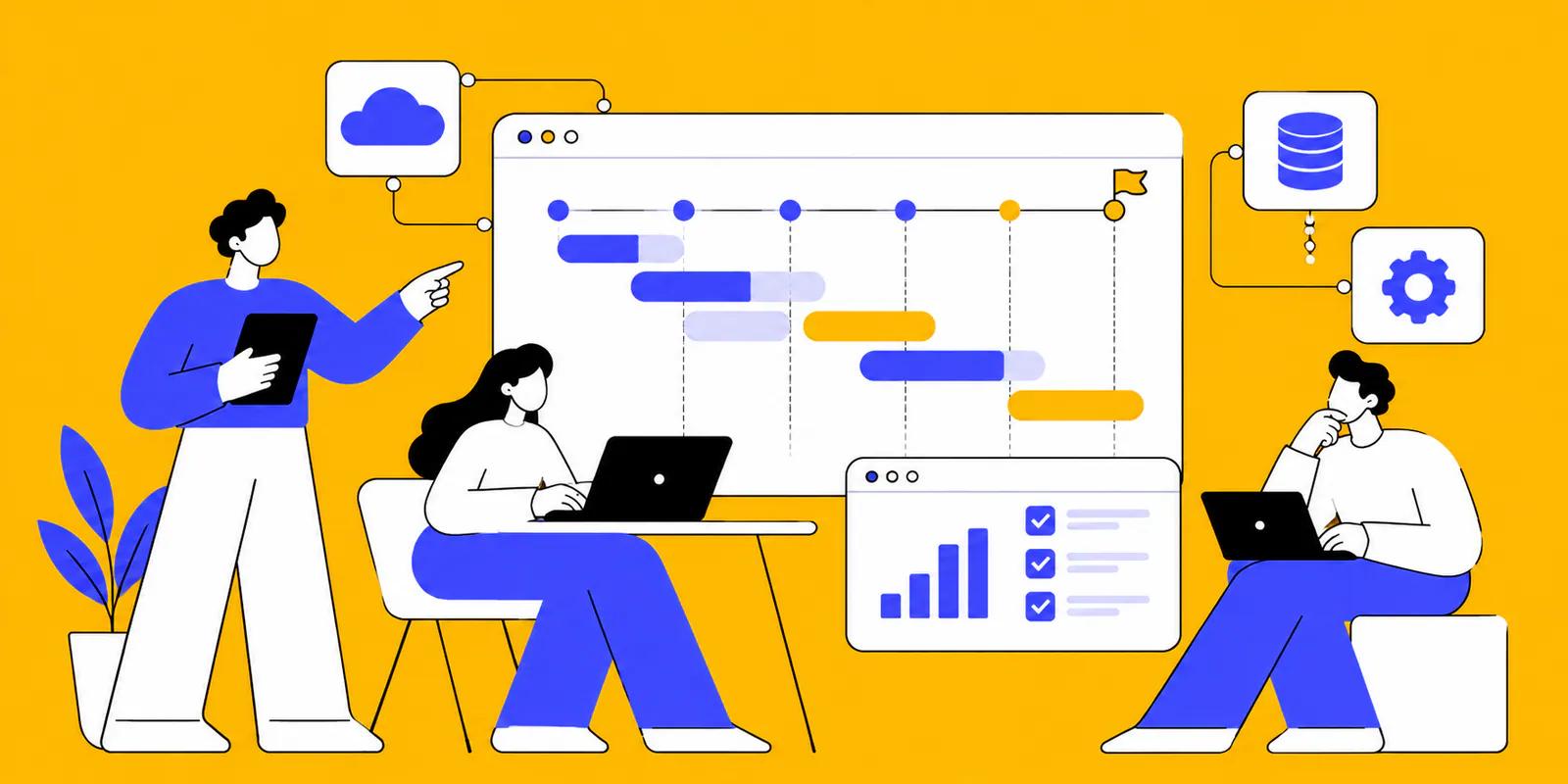
How Long Does It Take to Build a SaaS Application?
A focused SaaS MVP can often be planned around 8–16 weeks, a broader production SaaS application around 3–8 months, and a complex enterprise SaaS platform around 6–18+ months. These are planning ranges rather than promises. The actual schedule depends on product scope, architecture, team capacity, integrations, data migration, security, compliance and how quickly product decisions are made.
The most useful SaaS timeline is therefore not one launch date. It is a delivery model showing what will be built, which workstreams can run in parallel, which dependencies can block the critical path and what “production ready” means for the product.
SaaS Development Timeline at a Glance
A proof of concept may take 2–6 weeks. A focused MVP may take 8–16 weeks. A production SaaS product commonly takes 3–8 months. A complex platform can require 6–12 months, while enterprise SaaS with identity, migration, compliance and dedicated requirements can extend to 18 months or more.
A prototype, MVP and production platform should never be treated as interchangeable deliverables. A prototype proves an idea. An MVP validates a focused customer workflow. Production SaaS must also support real customers, protect data, process billing, recover from failures and operate continuously.
What Determines SaaS Development Time?
The largest variables are core workflow count, UX complexity, user roles, multi-tenancy, billing, integrations, migration, reporting, AI, mobile clients, security, compliance, performance targets and deployment requirements.
Team composition matters as well. A team with appropriate frontend, backend, QA and DevOps capacity can run independent workstreams in parallel. A small team may be efficient for an MVP but become a bottleneck when several specialized requirements arrive at once. Adding developers does not reduce the schedule linearly because architecture, dependencies, reviews and product decisions still have to happen in sequence.
Typical SaaS Application Timelines by Product Type
A focused SaaS MVP commonly fits within 8–16 weeks. An SMB-oriented production product may need 3–6 months. A B2B platform with organizations, permissions, billing and integrations may require 4–9 months. A complex product with several domains, automation and migration can take 6–12 months. Enterprise SaaS can take 6–18+ months when SSO, SCIM, compliance, audit, migration or dedicated infrastructure are required.
The ranges overlap intentionally. A narrow enterprise product can be smaller than a broad consumer platform. Scope and dependencies matter more than the label attached to the software.
Proof of Concept vs MVP vs Production SaaS
A proof of concept answers a technical question. It might demonstrate that an AI model works, an integration is feasible or a difficult query performs adequately.
An MVP answers a product question: can the target customer complete the main job and receive enough value to justify continued investment?
A production SaaS application answers an operational question: can the business reliably serve customers, protect their information, collect revenue, monitor the system and release changes safely?
Confusing these stages is a common source of underestimation. A demo can be produced quickly while the production version needs months of engineering and testing.
SaaS Discovery and Requirements Timeline
Discovery usually takes about 1–2 weeks for a focused product, although complex products can require much longer. The goal is to define users, organizations, workflows, permissions, integrations, data, billing and launch criteria before major implementation.
A good discovery phase identifies assumptions that could change the schedule. For example, “customers need CRM integration” is not enough. The team needs to know whether data is imported once, synchronized continuously, pushed in one direction or synchronized both ways. Those differences can represent very different engineering workloads.
UX and UI Design Timeline
A focused SaaS interface may take 1–3 weeks to establish core flows and visual direction. Larger products need more time for dashboards, settings, organization administration, permissions, onboarding, billing, responsive behavior and empty or error states.
Design can overlap with development after the primary flows are approved. This is one reason calendar time is not simply the sum of every team's hours. A good delivery plan separates design work that must be completed before engineering from design refinement that can happen during implementation.
SaaS Architecture Planning Timeline
Architecture for a focused SaaS product may take roughly 1–2 weeks, but architecture effort should reflect risk rather than a fixed calendar rule. The team may need to decide tenancy, identity, database structure, API boundaries, background jobs, storage, deployment, observability and integration strategy.
A modular monolith can be a practical starting point for many SaaS products. Microservices can be introduced when independent scaling, deployment or team ownership actually justifies their operational cost. Choosing a more complicated architecture does not automatically make the project faster or more scalable.
Core SaaS Development Timeline
Core development is usually the largest workstream. A focused product may need 5–12+ weeks for the main frontend, backend, database and workflows. Larger products add additional modules and dependencies.
The best estimation method is feature decomposition. Break each workflow into frontend behavior, API behavior, business rules, database work, permissions, notifications and tests. Estimating a complete feature as one line item often hides the work that makes the feature production-ready.
Authentication and User Management
Authentication can be straightforward when using an established provider, but SaaS user management becomes more involved when customers have organizations, invitations, roles, workspace switching and administrator controls.
Enterprise identity can add SSO, domain verification, SAML or OIDC configuration and SCIM provisioning. If these requirements are known, they should be included early because identity architecture affects user records, organization membership and authorization.
Multi-Tenancy and Tenant Isolation
Multi-tenancy can add development time because customer context must be preserved across API requests, database queries, storage, caches, queues, analytics and administrative operations.
A shared-schema model can reduce infrastructure complexity but requires strict tenant scoping. Schema-per-tenant and database-per-tenant models can provide stronger isolation while adding provisioning and migration work.
Tenant isolation should be tested explicitly. Authentication alone does not prevent cross-tenant access if an API or background job fails to enforce ownership.
Billing and Subscription Timeline
Billing can add days or several weeks depending on the pricing model. Fixed subscriptions are simpler than systems with seats, trials, coupons, upgrades, downgrades, proration, refunds, usage charges and multiple plans.
Payment providers process transactions, but the SaaS application still needs subscription state, entitlements and webhook processing. Webhooks may be duplicated or arrive later than expected, so idempotency and failure handling are part of the actual implementation and QA timeline.
Third-Party Integrations
A production integration involves much more than calling an API. Authentication, pagination, rate limits, webhooks, retries, synchronization, mapping, reconciliation, monitoring and error handling can all be required.
One straightforward integration may add several days or a couple of weeks. Several complex integrations can become a major workstream. High-risk integrations should be validated early, especially when they influence the core architecture or customer workflow.
Data Migration
Migration from spreadsheets, legacy applications or another SaaS product can become a separate project. The team may need to map fields, clean records, deduplicate data, preserve relationships, validate ownership and rehearse rollback.
Source-data quality is a major variable. A clean export with stable identifiers can be manageable. Historical data with missing relationships, inconsistent formats and duplicates can require substantial analysis and transformation.
AI Features and SaaS Timeline
AI can add little time when it is a contained API-assisted feature, or it can become a major subsystem. Advanced AI SaaS may require document ingestion, retrieval, vector search, evaluation datasets, model routing, usage metering, permissions and human review.
AI also requires product-quality evaluation. A model returning a valid response does not prove that the response is useful or safe for the customer's workflow. Evaluation and fallback behavior should be included in the estimate rather than treated as optional after development.
Mobile Applications
A SaaS web application can share backend services with mobile applications, but iOS and Android still need separate client development and testing. Push notifications, offline behavior, deep links, device capabilities and mobile-specific workflows can increase the schedule significantly.
If mobile is not essential to the initial customer outcome, a responsive web release can sometimes reduce first-release scope. If mobile is core to the product, it should be included in the initial architecture and timeline rather than added as an afterthought.
Security and Compliance
Security requirements include authentication, authorization, secrets management, input validation, dependency management, encryption where appropriate, logging, backups and incident handling.
Enterprise and regulated products can add audit logs, SSO, retention controls, security assessments, penetration testing, data residency and formal compliance activities. These requirements can affect architecture and storage decisions, so discovering them late can cause rework and schedule expansion.
QA and Testing Timeline
QA should run throughout the project rather than only during the final week. A focused SaaS release may need 2–4 weeks of concentrated hardening, with earlier testing happening during development.
Testing should cover workflows, permissions, tenant isolation, billing state transitions, integrations, retries, imports, exports, performance and failure scenarios. A SaaS system can pass happy-path testing while still containing serious cross-tenant or subscription-state defects.
Performance and Scalability Testing
Performance requirements depend on actual usage patterns. A product serving a small number of low-volume tenants behaves differently from a product with fewer but extremely active customers.
Testing should identify likely bottlenecks such as database queries, connection pools, queue workers, third-party limits, storage and API latency. Scaling work should follow measurement. Designing every component for extreme scale before customer usage exists can increase complexity without improving the first release.
Deployment and Production Hardening
Production launch commonly needs 1–2 weeks of concentrated deployment and hardening work, although infrastructure may be developed earlier. The work can include CI/CD, secrets, monitoring, alerts, backups, database migrations, rollback procedures, domains, certificates and environment configuration.
Production readiness is part of development time. If deployment is postponed until the final day, infrastructure defects can become launch blockers.
Client Dependencies and Approval Time
Client decisions can materially change the calendar. Missing credentials, unclear workflows, delayed design approvals or unavailable subject-matter experts can block engineering.
A predictable process defines decision owners, approval windows, acceptance criteria and a prioritized backlog. Regular demonstrations help surface misunderstandings before they become expensive rework.
Scope Creep and Rework
Scope creep does not only add the estimated time for a new feature. It can change APIs, database models, permissions, tests, UX and documentation.
A useful change-control process records what changed, why it changed, which existing work is affected and whether the target launch date changes. This makes timeline discussions factual instead of relying on informal expectations.
Critical Path
The critical path is the chain of dependent work that controls the earliest possible launch. A simplified SaaS path might be architecture, data model, authentication and tenant foundation, core workflow, billing or critical integration, QA and production release.
Other work can run in parallel. Documentation, design refinement and testing of completed modules may not block the critical path. Identifying the path explains why adding another developer may not solve a particular dependency.
How to Shorten the SaaS Timeline Safely
The safest acceleration strategies reduce uncertainty and unnecessary scope. Narrow the MVP. Validate difficult integrations early. Reuse proven services where they meet requirements. Establish API and data contracts before parallel engineering begins. Automate testing and deployment.
Managed databases, object storage, queues and monitoring can also reduce infrastructure work. AI-assisted coding can speed up repetitive implementation, but architecture, security and QA still require review.
Agile vs Waterfall
Agile does not mean there is no timeline. It means the product is delivered incrementally and priorities can adapt as evidence changes.
Waterfall-style planning can work when requirements are stable and extensive upfront documentation is required. SaaS projects often benefit from iterative delivery because real customer feedback can change priorities.
A practical approach can combine a fixed MVP scope with short iterations and regular demonstrations.
SaaS Timeline and Development Cost
Timeline and cost are related but not identical. A small team can require a longer calendar duration with lower concurrent cost. A larger team can shorten some workstreams while increasing total monthly spend.
A simple planning model is engineering cost equal to team capacity multiplied by duration and blended rate, followed by infrastructure, third-party services, security, migration and support costs where applicable.
For budget decisions, timeline assumptions should be shown alongside staffing assumptions.
How to Estimate a SaaS Timeline Step by Step
First define the target customer and launch outcome. Then list the required workflows and separate must-have features from later ideas.
Next define users, organizations, roles, tenancy, data, billing, integrations, migration and security requirements. Break each workstream into deliverables and estimate them independently.
Map dependencies, identify the critical path, include QA and production hardening, then add contingency for known uncertainty. Review the estimate against the actual team capacity and client availability.
A range with visible assumptions is more useful than a precise date that has no traceable calculation.
Small, Medium and Large SaaS Teams
A small team may include a product owner, designer, two to four engineers and shared QA or DevOps support. This can work well for a focused MVP.
A medium team can run frontend, backend, design and QA work in parallel when interfaces are stable. A larger team can add specialists for security, data, DevOps and enterprise requirements.
The right question is not “how many developers can we add?” but “which bottleneck is preventing the next milestone?”
Realistic 12-Week MVP Roadmap
Weeks 1–2: discovery, requirements, architecture, UX flows and backlog.
Weeks 3–4: authentication, organizations, roles, database foundation and frontend shell.
Weeks 5–8: primary workflow, APIs, dashboard, business rules and essential notifications.
Weeks 9–10: billing, required integrations, background jobs and edge cases.
Week 11: QA, security, tenant-isolation testing and performance checks.
Week 12: production hardening, monitoring, backups, documentation and controlled launch.
This roadmap assumes a deliberately focused MVP. Additional modules, mobile apps, complex integrations or migration can extend it.
Realistic Six-Month Production Roadmap
Month 1 can cover discovery, validation, requirements, UX, architecture and foundations. Month 2 can establish authentication, organizations, data models and the primary workflow. Month 3 can expand core functionality, APIs, notifications, billing and first integrations.
Month 4 can add secondary workflows, reporting, background jobs and migration tooling. Month 5 can concentrate on QA, security, performance, UAT and production hardening. Month 6 can cover controlled launch, monitoring, onboarding and the first post-launch iteration.
This is an example planning model, not a standard promise.
SaaS Launch Readiness Checklist
Before launch, verify that core workflows work end to end; authentication and authorization are enforced correctly; tenant isolation has been tested; billing states work; webhook processing is idempotent; integrations have retry and failure handling; backups exist and restoration is understood; monitoring and alerts are active; error tracking is available; rate limits are configured; data export and deletion requirements are addressed; deployment and rollback are documented; analytics measure activation; onboarding is ready; and support escalation is defined.
Questions to Ask a SaaS Development Company About Timeline
Ask whether the estimate is for a prototype, MVP or production SaaS. Ask whether design, QA, DevOps, deployment, billing, multi-tenancy, integrations, migration, security and launch support are included.
Ask which assumptions affect the date, what the critical path is, what the client must provide and how scope changes are handled.
A credible estimate should connect time to deliverables, staffing and dependencies. It should explain what could move the date instead of presenting an attractive number without assumptions.
How Axora Infotech Approaches SaaS Timelines
Axora Infotech approaches SaaS timelines by separating the MVP from future product ideas, then mapping workflows, architecture, integrations, data requirements and production-readiness work into delivery phases.
For web SaaS products, Axora can work with React, Next.js, Node.js, NestJS, PostgreSQL, MongoDB, Redis, AWS and Google Cloud. The exact stack is selected around product requirements.
The goal is not to promise an arbitrary launch date. The goal is to produce a timeline showing what will be built, what depends on what, what can run in parallel and what conditions are required for production.
Frequently Asked Questions
How long does it take to build a SaaS application? A focused MVP commonly takes 8–16 weeks, broader production SaaS can take 3–8 months, and complex enterprise products can take 6–18+ months.
Can a SaaS application be built in three months? A focused MVP can fit into about three months when scope is controlled and decisions are fast. Complex enterprise scope should not be assumed to fit the same window.
Can a SaaS product be built in six months? Six months can be enough for many production SaaS products when the initial release is clearly scoped. Enterprise capabilities can continue in later phases.
Does multi-tenancy increase development time? It can because tenant-aware authorization, data access, storage, queues and testing add requirements.
Does AI make SaaS development faster? AI can accelerate coding and documentation but does not remove architecture, security, testing, integration and operations.
What makes SaaS estimates more accurate? Clear requirements, explicit assumptions, known dependencies, acceptance criteria and a defined team make estimates more reliable.
What should a SaaS timeline include? Discovery, design, architecture, development, integrations, billing, QA, security, deployment and launch readiness, plus migration, mobile, AI or compliance work when required.
How Product Scope Maps to Calendar Time
A useful way to estimate SaaS development is to separate the product into capability groups rather than counting screens. Authentication and account management may be one capability. The core business workflow may be another. Billing, reporting, integrations, notifications and administration can each become their own workstreams.
For each capability, estimate design, frontend, backend, database, permissions, tests and deployment impact. Then identify whether it depends on another capability. This prevents a dashboard containing twenty screens from being treated as twenty independent tasks when they may all depend on one shared data model.
Scope should also be classified by release. Must-have functionality belongs in the launch estimate. Valuable but non-essential functionality belongs in a later milestone. Ideas that have not been validated should not silently become part of the committed timeline.
How Business Rules Increase SaaS Development Time
Business rules are often more expensive than interface screens. A form can be implemented quickly, but rules such as approval chains, role restrictions, subscription entitlements, limits, exceptions and automated actions create branches that must be implemented and tested.
For example, “users can invite teammates” is a simple statement. The real system may need to decide who can invite, which plan allows invitations, whether pending invitations count toward limits, what happens when the invitation expires and whether an invited user can belong to another organization.
During estimation, these rules should be documented because they affect APIs, database constraints, frontend states and QA cases. The more conditional behavior a SaaS product has, the more important acceptance criteria become.
How Reporting and Analytics Affect the Timeline
Dashboards and reports can add significant effort when they combine large datasets, filters, date ranges, permissions and exports. A simple count on a small table is very different from a customer-facing report that aggregates millions of events.
Reporting may require optimized queries, materialized data, background generation, caching or a separate analytics store. Export functionality can also become a background job when files are large.
Product analytics creates another requirement. The team needs consistent event definitions, tenant context and privacy controls. If analytics are planned from the beginning, instrumentation can be added alongside workflows rather than reconstructed after launch.
How Notifications Affect SaaS Development Time
Email, SMS, push and in-app notifications look small but can create many states. The system may need templates, preferences, localization, queues, retries, provider failures, unsubscribe behavior and audit information.
Notification work becomes more complex when messages are triggered by billing events, user invitations, workflow changes or scheduled jobs. Background processing is often appropriate so a slow external provider does not block a user-facing request.
For estimation, count notification channels and trigger types rather than treating “notifications” as one generic task.
How Search and File Processing Affect Timeline
Search can be simple database filtering or a dedicated subsystem with indexing, relevance, faceting, typo tolerance and permissions. File-heavy SaaS products can also require upload processing, previews, OCR, virus scanning, thumbnails and asynchronous transformation.
Large files should usually be handled through controlled object-storage flows rather than passing every byte through the application server. Search indexes and file-processing jobs must preserve tenant context.
If search or media processing is core to the product, validate the expected data volume early. The architecture required for ten thousand records may differ from what is needed for tens of millions.
How Customer Onboarding Affects Launch Time
SaaS products need more than a signup page. A useful onboarding experience may include organization creation, invitations, profile setup, initial configuration, sample data, integration setup and a first successful workflow.
If onboarding requires manual engineering or operations for every customer, the product may not scale as a SaaS business even if the application itself works. Self-service provisioning therefore becomes part of the product architecture.
Onboarding should also be measured. Events such as signup, configuration completion and first successful workflow can reveal where customers get stuck and inform post-launch priorities.
How Support and Operations Affect the SaaS Timeline
A production SaaS product needs an operating model. Someone needs to know when an integration fails, a payment webhook is delayed, a queue stops processing or a customer reports an unexpected result.
Operational tooling can include logs, metrics, traces, alerts, admin views, retry controls and tenant-level diagnostics. These tools may not appear in the customer-facing product but can materially reduce incident resolution time.
Support requirements should be discussed before launch. If customers require response commitments, status communication or audit information, the engineering design may need additional monitoring and administrative capabilities.
Why Estimates Change During SaaS Development
Early estimates are uncertain because the team does not yet know every dependency. Discovery reduces uncertainty, architecture exposes technical constraints, implementation reveals edge cases and customer feedback changes priorities.
A healthy estimation process therefore updates the forecast when new information appears. The change should be explained by a specific cause: a new integration requirement, additional role model, migration issue or security requirement.
This is different from repeatedly moving the date without explanation. Transparent re-estimation gives stakeholders a way to decide whether to reduce scope, add capacity or accept a later release.
How to Build a SaaS Timeline for a Fixed Launch Date
Sometimes a business has a fixed commercial date such as a customer commitment, event or market window. In that situation, the timeline should work backward from the date and identify the latest acceptable completion point for each critical milestone.
The team can then separate fixed launch requirements from features that can ship later. High-risk integrations and architectural decisions should be pulled forward because late discovery has less recovery time.
A fixed date does not make the engineering work smaller. It changes the planning tradeoff between scope, staffing, risk and release quality. The team should explicitly document which of those variables is being changed to meet the date.
What a Good SaaS Timeline Deliverable Looks Like
A useful project timeline should contain milestones, deliverables, dependencies, assumptions, owners and acceptance criteria. It should identify the critical path and show which workstreams are parallel.
It should also distinguish development complete from production ready. A feature can be coded but still need QA, security review, migration testing, documentation or deployment configuration.
For client-facing estimates, show what is included and what is not included. This prevents later disagreements when a proposal says “billing” but the stakeholders mean trials, proration, invoices, refunds, usage metering and failed-payment recovery.
| Product type | Planning range | Typical scope |
|---|
| Focused SaaS MVP | 8–16 weeks | Core workflow, authentication, tenant foundation and basic billing |
| SMB production SaaS | 3–6 months | Multiple workflows, roles, integrations, analytics and operations |
| B2B SaaS platform | 4–9 months | Organizations, permissions, billing, integrations and stronger security |
| Complex SaaS | 6–12 months | Multiple domains, automation, migration and scale |
| Enterprise SaaS | 6–18+ months | SSO/SCIM, compliance, audit, migration and enterprise operations |
| Phase | Typical range | Main output |
|---|
| Discovery and scope | 1–2 weeks | Requirements, MVP scope and delivery plan |
| UX/UI design | 1–3 weeks | User flows, wireframes and interface direction |
| Architecture | 1–2 weeks | Technical design, tenancy, data and infrastructure plan |
| Core development | 5–12+ weeks | Frontend, backend and primary workflows |
| Integrations and billing | 1–5 weeks | Payments, external services and subscription behavior |
| QA and hardening | 2–4 weeks | Functional, security, isolation and performance validation |
| Deployment and launch | 1–2 weeks | Production infrastructure, monitoring, backups and release |
How Dependencies Change the SaaS Timeline
A SaaS project rarely consists of completely independent tasks. The frontend may depend on an API contract, the API may depend on the data model, billing may depend on the subscription model, and customer onboarding may depend on both identity and tenant provisioning. A timeline should make those dependencies visible.
Dependencies are especially important when an external company controls part of the workflow. Payment approval, identity-provider configuration, marketplace review, API credentials or customer data exports can all create waiting periods that engineering cannot remove simply by adding developers.
During planning, mark each dependency as internal, client-controlled or third-party-controlled. High-risk dependencies should be validated early and should have a fallback where practical.
What Is Included in a Production SaaS Launch?
A production launch is more than deploying the latest build. The application needs a stable environment, production configuration, secure secrets, database migrations, backups, monitoring, alerting, error tracking and a rollback strategy.
The product should also have operational workflows for failed jobs, integration errors and customer support. If customers can subscribe, billing state must be reliable. If customers upload data, storage permissions and retention should be defined. If multiple organizations share resources, tenant isolation should have explicit tests.
These activities may not create visible screens, but they are part of the calendar required to move from “feature complete” to “safe to operate.” A timeline that excludes them can look attractive while understating the real launch effort.
SaaS Timeline Buffer and Estimation Confidence
Early estimates should normally be treated as ranges because requirements and technical constraints are still being discovered. After discovery and architecture, the team can usually narrow the range because major unknowns have been reduced.
Instead of adding an arbitrary percentage to every task, identify specific uncertainty. A new payment integration may have unknown webhook behavior. A migration may have unknown data quality. An AI workflow may have unknown evaluation requirements. These risks can receive explicit contingency.
A good estimate also records confidence. High-confidence work has clear acceptance criteria and known technology. Lower-confidence work depends on external systems, unresolved product decisions or unfamiliar technical constraints. This makes the forecast easier to update as the project progresses.
When Should a SaaS Product Launch?
Launch readiness should be based on the smallest reliable customer outcome, not on the number of features completed. If the core workflow works, customers can onboard, data is protected, billing is reliable and the team can monitor and support the product, a focused release may be possible while secondary features remain on the roadmap.
A later launch can be justified when a missing capability is essential to the target customer's workflow, required by a contract or necessary for security or compliance. The decision should be tied to an explicit requirement rather than a general feeling that the product needs to be bigger.
This approach lets the company treat the first release as a real product while continuing to develop the broader platform.
SaaS Timeline for Different Business Models
B2B SaaS often spends more time on organizations, permissions, approvals, integrations and reporting. B2C SaaS can instead spend more time on onboarding, high-volume traffic, consumer billing, notifications, mobile experiences and acquisition-related flows.
Vertical SaaS can require industry workflows, terminology and compliance requirements. Horizontal SaaS may have a broader feature surface because it serves multiple industries. Enterprise SaaS can add identity, procurement, security reviews and migration.
These differences matter because a timeline based only on the number of screens misses the engineering behind the operating model. Two applications with the same number of screens can have very different backend, security and integration requirements.
SaaS Development Timeline After the MVP
The first launch is not the end of the SaaS timeline. After release, the roadmap normally shifts from proving the core workflow toward improving retention, expanding integrations, strengthening operations and supporting larger customers.
Post-MVP work can include additional roles, advanced analytics, automation, API access, enterprise SSO, migration tools, mobile clients, localization and dedicated infrastructure. These should be treated as separate roadmap phases instead of silently expanding the original MVP estimate.
Real customer behavior is particularly useful at this stage. Usage data can show which features deserve investment and which proposed features are not actually needed. This can prevent the product from accumulating unnecessary complexity.
How to Compare Two SaaS Development Estimates
Two vendors can give different timelines without either estimate being automatically wrong. One may include design, QA, DevOps and production hardening while another counts only engineering implementation.
Compare estimates by deliverables and assumptions. Check the proposed team, expected hours or capacity, milestones, integrations, environments, testing, deployment, migration and post-launch work. Ask which requirements are explicitly excluded.
Also compare the definition of MVP. One proposal may mean a clickable demonstration while another means a production-ready product that can accept paying customers. The word MVP alone is not enough to make estimates comparable.
How SaaS Timeline Estimates Handle Unknowns
Unknowns should be separated from known work instead of hidden inside a single number. If the product depends on an API that has not been tested, the integration estimate has lower confidence. If the data model is still changing, backend estimates also have lower confidence.
A useful plan records assumptions beside each milestone. For example, the billing milestone may assume one payment provider and two plans; the migration milestone may assume a clean CSV export; the enterprise milestone may assume standard SSO rather than a custom identity flow.
As assumptions become confirmed, the forecast can be narrowed. This makes the timeline a living planning artifact rather than a promise made once at the beginning of the project.
How SaaS Teams Track Timeline Progress
Milestone progress should be measured by accepted deliverables rather than hours spent. A feature is not complete simply because code has been written; it may still need review, testing, integration and acceptance.
Teams can track planned versus completed work, blocked items, dependency status, defect trends and remaining critical-path work. Short demonstrations provide another useful signal because stakeholders can see whether the product behavior matches the intended outcome.
When a milestone slips, identify the cause before moving every downstream date. Sometimes the delay affects only one non-critical workstream. Other times it changes the critical path. This distinction makes project reporting more accurate.
SaaS Timeline Risks to Review Weekly
Weekly risk review can focus on scope changes, unresolved product decisions, external dependencies, integration failures, migration quality, security findings, critical defects and infrastructure readiness.
Risk should be tied to an owner and next action. A vague risk such as “billing may take longer” is less useful than “webhook retry behavior is not yet validated; payment integration owner will test it before the billing milestone.”
Tracking these risks early gives the team more options. A feature can be reduced, an integration can be mocked temporarily, additional capacity can be assigned or a later milestone can be moved without surprising stakeholders at launch.
What Makes a SaaS Timeline Realistic?
A realistic SaaS timeline connects scope to a capable team, allows work to overlap where dependencies permit, includes QA and production hardening, and makes external dependencies visible.
It also leaves room for normal engineering uncertainty. The objective is not to maximize optimism or pessimism. It is to create a forecast that can be explained and updated when facts change.
For buyers, this means a useful development proposal should show milestones, deliverables, assumptions and acceptance criteria. For product teams, it means keeping the first release narrow enough that the core customer outcome can reach production without sacrificing the reliability needed to operate a real SaaS business.
Research & Further Reading
Microsoft Azure — SaaS and Multitenant Solution Architecture →
Microsoft Azure — Design Methodology for SaaS Workloads →
AWS Well-Architected — SaaS Lens →
AWS SaaS Lens — Tenant Isolation →
AWS SaaS Lens — SaaS Identity →
Scult — SaaS Development Guide 2026 →
RaftLabs — SaaS Application Development Guide 2026 →
Notix — SaaS Development Guide →
Technource — SaaS Application Development Guide →
Web Atlas Tech — SaaS Application Development Cost 2026 →
Related Axora Resources
SaaS Application Development: Complete Guide for 2026 →
SaaS Development Cost in 2026 →
Custom Software Development Process →
How Long Does Custom Software Development Take? →
Custom Software Development Cost in 2026 →
Custom Software vs Off-the-Shelf Software →
Custom Software Development for Startups →
Enterprise Custom Software Development →
How Much Does It Cost to Hire a Software Development Team? →
Axora Infotech Services →
Contact Axora Infotech →